
Choosing the Façade
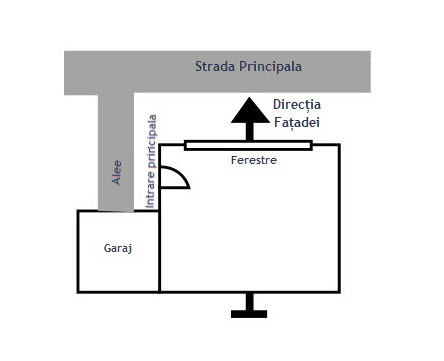
Determining the facing direction of a building, or of a part of it such as an apartment, a shop or an office, depends on the following factors:
- the direction in which the outside environment is predominantly yang in nature;
- the exposure of the building, or of a part of it, to the outside environment;
- the internal structure of the building or part of the building, which allows yang energy to spread to all of its sectors.
Determining the directions correctly is essential to the success of any Feng Shui audit. The trigram of the building, apartment, office or shop is determined on the basis of these directions. First, you must determine the front of the property which, contrary to many beliefs, does not always have to be on the same side as the main door.
If we imagine the building as a person sitting cross-legged and looking at a landscape, we can get an impression of which direction is the sitting (supporting) direction and which is the facing direction of the building.
These two directions are understood as the directions from which two different “Stars” result. The term “Stars” used here has nothing to do with the stars of astronomy. These two Stars are referred to in different ways. The Facing Star is also called the Water Star or the Money Star, while the Sitting Star is also called the Mountain Star or the People Star.
The Water Star refers to the front of the building being analyzed. In Chinese, the term is Hsiang Hsing.
The Mountain Star corresponds to the back of the building being analyzed. The Chinese term uses the Chinese character for mountain: Shan Hsing or Tsuo Hsing.
These two Stars are associated with two of the main aspects of life. The Mountain Star is associated with family, relationships, health and fertility. The Water Star is associated with wealth, finances and career.
Many aspects must be taken into account when determining the orientation of a building, but the fundamental rule is that the sitting direction and the facing direction are always magnetically opposite. The orientation of a building must be “felt”. For a few moments we can treat the building as a being and ask ourselves “which way is it looking?” and “where is it sitting?”. Many buildings are clear, and often have large windows or doors (like eyes) at the front. Although the main door is generally on the front side of the house, in some cases it represents neither the sitting nor the front of the building. It is important not to confuse the position of the main door (which matters in other types of Feng Shui) with the facing direction in the Xuan Kong Fei Xing (Flying Stars) Feng Shui method, the method we use.
The facing direction is the direction through which the maximum amount of yang energy enters. The part of the building that faces the greatest amount of yang energy is the front of the building, provided that energy can enter through large doors, windows and entrances. Yang has an expanding movement and represents the active principle in nature, which manifests as light, growth and warmth. The environment around the building must also be examined to find the direction in which yang is predominant.
Apart from this, the overall shape and structure of the building must also be considered in order to identify the front, since energy passes through large surfaces more easily than through small ones. The side of the building with the most-used entrances and the most windows must be identified. If this side is also exposed to the maximum yang energy of the environment, then it will be the front. Many buildings are like this.
If the overall shape and exposure of the building and the direction of maximum yang energy in the surrounding environment do not coincide, you must decide which side seems the most exposed and open to the outside energy.
The ease with which energy spreads through the building is also important.
Determining the front of a part of a building, such as an apartment, office or shop, depends on the way energy enters it. You must find out whether energy enters through the direction of the front of the building or through some other direction. If energy enters the apartment from more than one direction (for example, the front direction of the building), you must find out which direction the energy predominantly comes from.
Determining the two directions can be a challenging task and requires attention, a good knowledge of the fundamentals and experience.
Looking for a personalized analysis of your space or destiny?
Contact us for Feng Shui, BaZi or QiMen consulting. We offer clarity, authentic traditional solutions and precisely calculated remedies.
Recommended articles
The Five Elements Theory
Although the term Five Elements is commonly used, the correct term is Five Phases, referring to wood, fire, earth, metal and water. They are called Phases because they involve a continuous transformation and interaction among them.
The Eight Trigrams
It is said that the legendary king and sage Fu Xi, around 4500 BC, divided the forces of nature into two categories: those in strong, aggressive motion (active) and those that do not move, that are quiet and passive (inactive)...
Xuan Kong Feng Shui
Xuan Kong means the Flying Stars School and is the oldest and most authentic school of Feng Shui. It has two components: Xuan Kong Fei Xing (the Flying Stars system) and Xuan Kong Da Gua (the method of the 64 hexagrams)...