
The Eight Trigrams
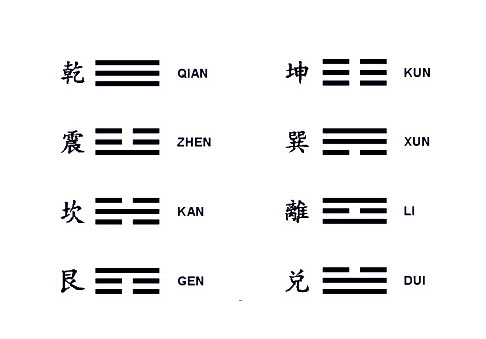
It is said that the legendary king and sage Fu Xi, around 4500 BC, divided the forces of nature into two categories: those in strong, aggressive motion (active) and those that do not move, that are quiet and passive (inactive). He used a straight, unbroken line to represent movement (yang) and a broken line to represent inactivity (yin). This is the origin of the principles of Yin and Yang. The two principles are opposite and complementary, and they are inseparable. Together, yin and yang represent the law of nature: unceasing change. The Tai-Chi symbol is round and illustrates the eternal interaction between yin and yang. The round figure should be seen as three-dimensional or spherical, because the Universe exists and coexists at the same time on different planes.
The interaction between yin (the feminine principle) and yang (the masculine principle) gave rise to four offspring by adding a yin or yang line on top. The four bigrams represent the order of the Universe. They stand for the four seasons, the four cardinal directions (N, S, E, W) and the stages of life (birth, old age, illness and death).

By adding a yin and a yang line on top of each bigram, the eight trigrams arise (symbols made of three horizontal lines, which can be unbroken or broken). They represent the maximum number of yang/yin combinations taken three at a time, and the stages through which all phenomena in nature and in the human world pass.

The resulting symbols were named heaven, lake, fire, thunder, wind, water, mountain and earth. The eight trigrams are arranged in a specific sequence, with heaven at the top, in the south, and earth at the bottom, in the north. This arrangement symbolizes natural phenomena, or the forces of nature, which is why the trigrams are considered to have a protective role. There are two arrangements of the trigrams, called the one before Creation (Early Heaven) and the one after Creation (Later Heaven). The arrangement of the eight trigrams was reworked to reflect the change of the elements across the four seasons. Thunder and wind were placed in the east and south-east, because they correspond to the wood phase, which represents spring. Fire was placed in the south to symbolize summer; the trigrams corresponding to the metal element, lake and heaven, were placed in the west and north-west to symbolize autumn; and earth and mountain, corresponding to the earth element, were placed on opposite sides, one in the south-west and the other in the north-east. This is the central line of the Taiji, which reflects the importance of earth throughout the year.
Looking for a personalized analysis of your space or destiny?
Contact us for Feng Shui, BaZi or QiMen consulting. We offer clarity, authentic traditional solutions and precisely calculated remedies.
Recommended articles
The Five Elements Theory
Although the term Five Elements is commonly used, the correct term is Five Phases, referring to wood, fire, earth, metal and water. They are called Phases because they involve a continuous transformation and interaction among them.
Xuan Kong Feng Shui
Xuan Kong means the Flying Stars School and is the oldest and most authentic school of Feng Shui. It has two components: Xuan Kong Fei Xing (the Flying Stars system) and Xuan Kong Da Gua (the method of the 64 hexagrams)...
The Luo Pan Compass
The Luo Pan is the compass used for every Feng Shui assessment. It was invented during the time of the Yellow Emperor, around 2700 BC. Initially it was used to determine directions...