The Five Elements Theory
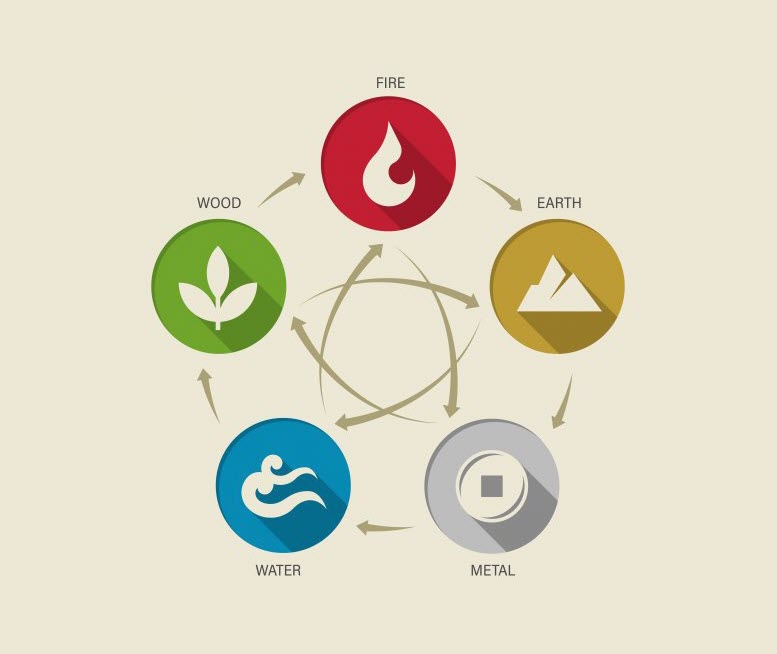
Strictly speaking, the correct term is “the five phases”, and it refers to wood, fire, earth, metal and water. They are called phases because they describe a continuous transformation from one into the next, as well as an interaction among those present simultaneously in a given context.
Thus the upper part of the Taiji symbol, which holds maximum Yang, is considered to correspond to the action of FIRE, the direction south, summer, heat, the bitter taste, the colors red, orange and deep yellow, and the emotion of joy and laughter.
The lower part of the Taiji symbol, which holds maximum Yin, is considered to correspond to the action of WATER, the direction north, winter, cold, the salty taste, the colors blue and black, and the emotion of fear and weeping.
Similarly, the action of WOOD represents the left side of the Taiji symbol, where Yin transforms into Yang, the two being in roughly equal “quantities”. It corresponds to the direction east, spring, wind, the sour taste, the color green, and the emotion of anger and shouting.
The action of METAL represents the right side of the Taiji symbol and the transformation of Yang into Yin. It corresponds to the direction west, autumn, dryness, the pungent taste, the color white, and the emotion of sadness and hiccups.
Finally, the action of EARTH can no longer be tied to any of the four directions, which have now been used up... Earth is a more special action or movement. It corresponds to the center and can be associated with the end of summer, because for the Chinese (and lately for us as well) the summer season has grown longer. It is associated with dampness, the sweet taste, the emotion of reflection and singing.
You may have wondered why we used the notion of phases, movements or actions rather than elements. The reason is that these five activities (like Yin and Yang) represent a state that exists only for a moment, an energy in continuous transformation, without rest. Rest is associated with a state of illness, as is chaotic, unbalanced movement. They can therefore be regarded as Phases. The phase called Wood is associated with active functions that are growing. Fire designates functions that have reached their peak of activity and are about to decline or stop. Metal represents functions in decline. Water represents functions that have reached their maximum state of rest and will next follow an ascending direction. Finally, Earth designates balance or neutrality, acting as a kind of buffer between the other phases.
Looking for a personalized analysis of your space or destiny?
Contact us for Feng Shui, BaZi or QiMen consulting. We offer clarity, authentic traditional solutions and precisely calculated remedies.
Recommended articles
The Eight Trigrams
It is said that the legendary king and sage Fu Xi, around 4500 BC, divided the forces of nature into two categories: those in strong, aggressive motion (active) and those that do not move, that are quiet and passive (inactive)...
Xuan Kong Feng Shui
Xuan Kong means the Flying Stars School and is the oldest and most authentic school of Feng Shui. It has two components: Xuan Kong Fei Xing (the Flying Stars system) and Xuan Kong Da Gua (the method of the 64 hexagrams)...
The Luo Pan Compass
The Luo Pan is the compass used for every Feng Shui assessment. It was invented during the time of the Yellow Emperor, around 2700 BC. Initially it was used to determine directions...