
The Luo Pan Compass
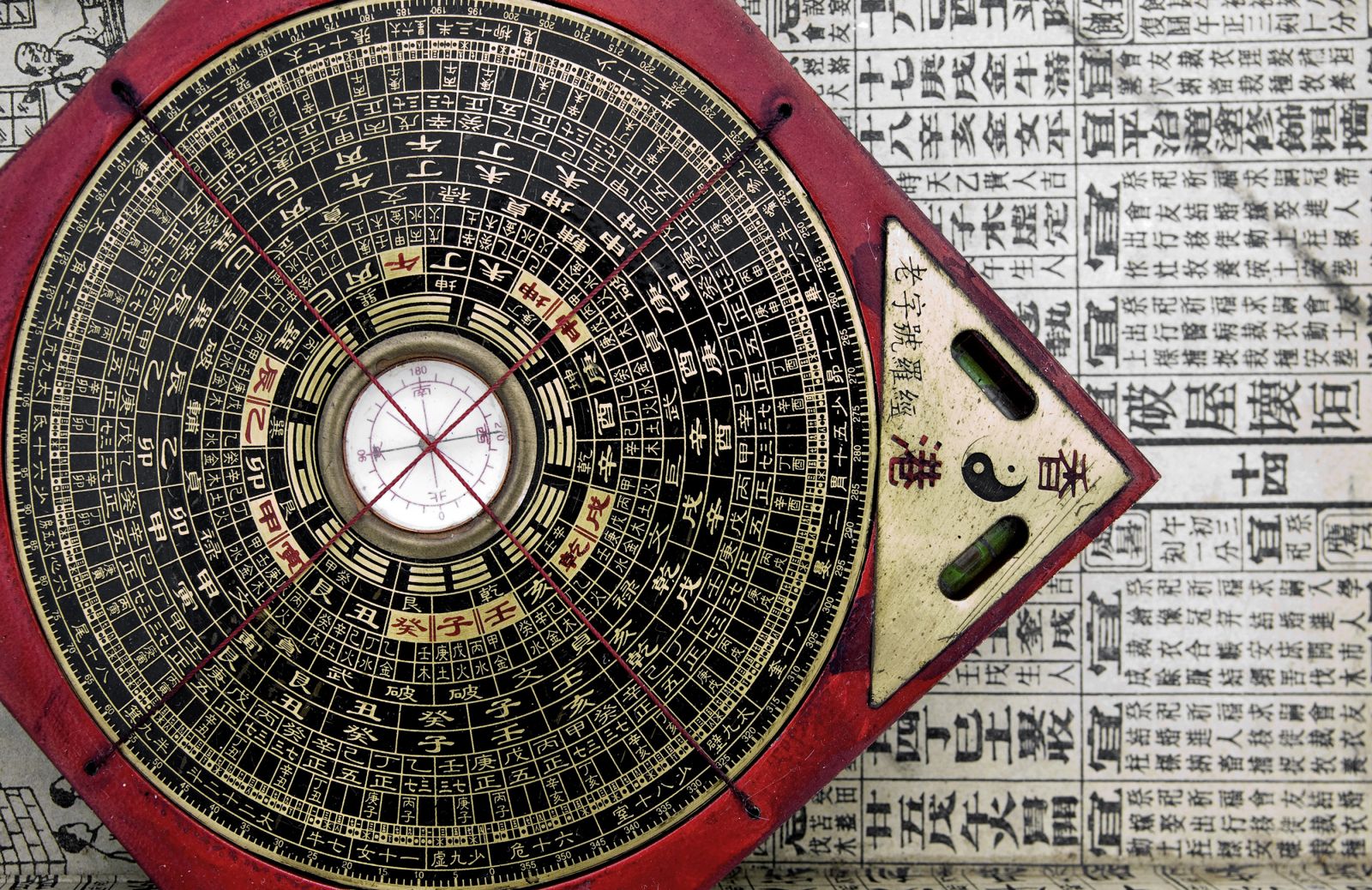
The Luo Pan is the compass used for every Feng Shui assessment. It was invented during the time of the Yellow Emperor, around 2700 BC. Initially it was used for determining directions and for navigation, and then it began to be used for Feng Shui evaluation. Over time, modifications were made by different masters, who founded different Feng Shui schools, and today there is a great diversity of Luo Pan compasses. The two most important schools today are San Yuan (the school of the three periods) and San He (the school of the three harmonies), each using a distinct Luo Pan.
Above we presented a Luo Pan compass that uses exclusively Chinese characters. Next, we present the compass we use in our analyses. You will notice that all the rings have been labelled, along with the meaning of the information they carry.

A Luo Pan compass contains several concentric rings. Some of the information is found on all compasses, and some is specific to a given school. Traditional compasses use only Chinese ideograms. Bilingual compasses have also appeared (partly in English, partly in Chinese). They contain the basic information in English as well, while the advanced information is always only in Chinese, because it is considered that a Feng Shui consultant who reaches a sufficiently advanced level needs to use information in Chinese and to know certain Chinese ideograms (both the pronunciation and, above all, the handwriting). Among the bilingual Luo Pan compasses we work with are those of Joey Yap and Vincent Koh.
In our projects we use mainly techniques from the schools of Joey Yap and Raymond Lo, with a secondary weight given to the approaches of Joseph Yu and Ulrich Lippelt. We successfully combine the techniques of several masters in the Feng Shui analyses we carry out. We do not consider any one method infallible. Instead, we confirm certain combinations of stars against events in the lives of the family members. In this way, a given manifestation in relationships, past events, certain ailments and the timing of their onset, or financial blockages tied to certain periods of time, is either confirmed or ruled out.

We consider the most exhaustive treatment of the Luo Pan across all existing schools to be that of Stephen Skinner in Guide to Feng Shui Compass. A compendium of Classical Feng Shui, which we believe must be in the library of every Feng Shui consultant. On the left you can see the cover of this encyclopedia. Skinner presents the 75 most important different rings used in the two main Feng Shui schools, as well as the history of the Luo Pan compass.
The San He School is based on balancing the harmony between heaven, man and earth. You can find information about the three types of Qi in the article Types of Qi. This school uses three rings of the 24 mountains. The inner ring is called the Earth Plate and is used to measure buildings and the objects in the surroundings, called the “Mountain” in Feng Shui. The middle ring is called the Man Plate and is used to measure objects around the property being analyzed, and the outer ring is called the Heaven Plate and is used to measure water (or the streets that run past the property). This plate is not found on the Luo Pan above, so for it I use a different Luo Pan.
In the San Yuan School there is only one ring of the 24 mountains, but this school makes greater use of time, for which there are distinct rings. Both schools have weak points and good points, so it is advisable to use and combine information from both. Both Joey Yap and Raymond Lo use both schools, and for this reason we follow the same approach. Skinner also presents both schools in detail, with the advantages of each, which is one more reason for us to use both depending on the situation.
Looking for a personalized analysis of your space or destiny?
Contact us for Feng Shui, BaZi or QiMen consulting. We offer clarity, authentic traditional solutions and precisely calculated remedies.
Recommended articles
The Five Elements Theory
Although the term Five Elements is commonly used, the correct term is Five Phases, referring to wood, fire, earth, metal and water. They are called Phases because they involve a continuous transformation and interaction among them.
The Eight Trigrams
It is said that the legendary king and sage Fu Xi, around 4500 BC, divided the forces of nature into two categories: those in strong, aggressive motion (active) and those that do not move, that are quiet and passive (inactive)...
Xuan Kong Feng Shui
Xuan Kong means the Flying Stars School and is the oldest and most authentic school of Feng Shui. It has two components: Xuan Kong Fei Xing (the Flying Stars system) and Xuan Kong Da Gua (the method of the 64 hexagrams)...