What Is the Best Place for Me?
Feng Shui means living in harmony with the environment, and it is a science with many different tools. The same house or office can be studied from different perspectives, using different methods of investigation. Let’s see how the landforms corresponding to the four celestial animals revered by the Chinese can offer us protection and security.
All ancient cultures worshipped the heavens and imagined gods and guardians in the form of celestial beings, generally represented as animals and revered in order to obtain protection. Chinese culture as we know it today developed from the worship of four celestial animals: the Vermilion Phoenix, the Azure Dragon, the Black Tortoise and the White Tiger. The Zangshu (the Book of Burial) describes how to locate the “Dragon’s Lair” – the place where Qi gathers, the most favorable spot to build a house or to bury the dead. Finding the “Dragon’s Lair”, a metaphor for the place where positive Qi accumulates, is the main goal of the Form School.
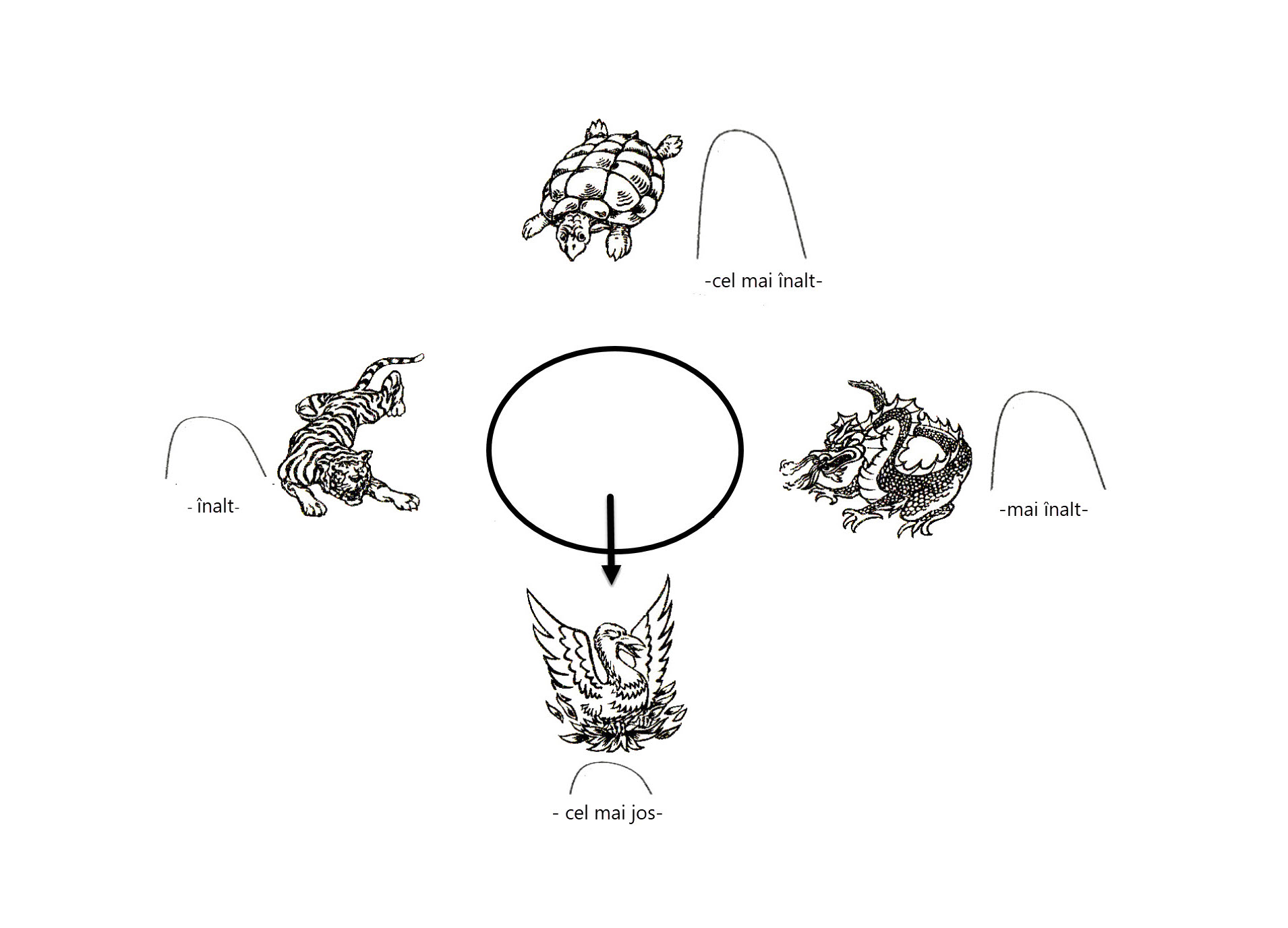
Imagine that the Dragon’s Lair is an armchair. The Tiger and the Dragon are the armrests, the Tortoise is the backrest, and the Phoenix is the footrest. Imagine that you are sitting in the armchair, looking in the direction of the arrow. You can understand the meaning of these animals by interpreting them psychologically, always imagining that they surround you. Our nervous system is aware that movements and objects behind us are excluded from our field of vision. So at our back we are vulnerable and we want support and protection. Here we want the strong shell of the tortoise. How would you feel if the armchair were missing its right or left arm? Off balance? Uncomfortable? The right side is the place of the Tiger, an animal with great strength but also the capacity for unleashed violence. This energy must be carefully controlled by keeping objects as close to the ground as possible. On the left is the Dragon, who is wise, broad-minded and stable, symbolizing our desire to have an open mind. This side should be higher than the Tiger’s. In Feng Shui, the Dragon and the Tiger protect the lair, just as the arms of an armchair protect our body. When we look ahead, we want a clear, unobstructed view. The Vermilion Phoenix does not provide protection as such; it plays rather the role of a barrier in front of external forces. The Phoenix is the bird of perpetual inspiration, and we want this feeling to extend as far as possible.
Some practical applications of this model are: choosing the best position for sitting, eating, sleeping or working, assessing the psychological impact of furniture, and establishing safe locations in a social setting.
Do you recognize the sensations and subtle disturbances caused by the absence of the animals?
Standing in the middle of a room, with our back exposed, we feel embarrassment, discomfort and a slight draft on the back of the neck. When we choose a chair, we choose our base. We should think of it as our home; it supports us for as long as we occupy it. When we sit on a stool, we are exposed from all sides. It can be used for a short meeting or a visit, but it is no coincidence that most people prefer a sturdier chair as their usual, permanent seat, with all the animals present. We feel safer and more relaxed, protected and able to direct our energy outward, and our creative side is free to express itself thanks to the Phoenix flying in front of us. Physiologically, when we rest our hands on the armrests of a chair, the pressure of the arms on the torso decreases, the chest moves more freely and we breathe more easily.
At night we must sleep well; we spend about a third of our lives in bed. It is important that the location of the sleeping area be as harmonious, protective and positive as possible. We need a strong Tortoise behind the head, a suitable configuration of the Dragon and Tiger sides, and a clear Phoenix aspect in front. The explanation for using the tortoise as the symbol of the space behind us lies in the strength of its shell, the extraordinarily strong home it always carries with it.
The time we spend at the office is also a significant part of our lives. We can use Feng Shui to determine the best location for the desk, the best direction to face, and the best position to occupy in meeting rooms.
The lowest landforms and watercourses are associated with the Vermilion Phoenix in the south. To maintain balance, the lofty landforms of the Black Tortoise rise in the north. The heights of the Azure Dragon in the east are balanced by the low forms of the White Tiger in the west.
If you live on flat land without a Tiger or a Dragon, that does not mean you will be unlucky. The four creatures can also be embodied by buildings, and these structures can represent the Dragon and the Tiger. If they are placed properly and are of suitable size, trees, built fences and shrubs can replace landforms and buildings.
Besides the cardinal points, the landforms of the Phoenix, Dragon, Tiger and Tortoise are associated with the seasons, the colors of the five phases, and yin/yang energy.
Although the four creatures correspond to the four cardinal points, we should not be so strict in our assessment. Keep in mind that, regardless of magnetic orientation, the most favorable position is with the Tortoise behind, the Dragon on the left, the Tiger on the right and the Phoenix in front.
Looking for a personalized analysis of your space or destiny?
Contact us for Feng Shui, BaZi or QiMen consulting. We offer clarity, authentic traditional solutions and precisely calculated remedies.
Recommended articles
The Five Elements Theory
Although the term Five Elements is commonly used, the correct term is Five Phases, referring to wood, fire, earth, metal and water. They are called Phases because they involve a continuous transformation and interaction among them.
The Eight Trigrams
It is said that the legendary king and sage Fu Xi, around 4500 BC, divided the forces of nature into two categories: those in strong, aggressive motion (active) and those that do not move, that are quiet and passive (inactive)...
Xuan Kong Feng Shui
Xuan Kong means the Flying Stars School and is the oldest and most authentic school of Feng Shui. It has two components: Xuan Kong Fei Xing (the Flying Stars system) and Xuan Kong Da Gua (the method of the 64 hexagrams)...