YIN and YANG
The concepts of Yin and Yang lie at the foundation of all Chinese metaphysics. They are opposite yet complementary and timeless principles, fundamental to Chinese thought and contained in the unity of the Taiji. Later, Yin and Yang came to represent the two primary aspects of the force of Qi.
Yin was described as the feminine principle of nature, seen as passive and weak. Yang was classified as the masculine principle of nature, seen as active and strong.
All manifestations in nature can be interpreted in terms of Yin and Yang; the identity of these terms is drawn from, and contained within, itself.
Originally, Yang referred to the side of living or inert things on Earth that was exposed to the sun, while Yin designated those in the shade. Yin is represented by the energy of the earth and by stable matter. Yin contracts and condenses. It represents the passive principle in nature, expressed through darkness, cold and moisture. On the human level it symbolizes femininity and inertia. Yin therefore stands for: concentration, withdrawal, rest, the lower part, the right side, the interior, darkness, stillness, cold, black, winter, the north, night, the moon, water, imagination, intuition, creativity, the back, inactivity, repose, sadness and weakness. Yang is the expression of heavenly energy. Yang has the quality of expanding. It represents the active principle in nature, expressed through light, warmth and dryness.
On the human level, Yang represents masculinity and the positive side of emotions. Other Yang traits include: expansion, dilation, agitation, the upper part, the left side, the exterior, light, noise, heat, day, white, summer, the south, sunlight, movement, the front, activity, firmness, analysis, exuberance and aggression. These traits are not exhaustive.
With minimal effort, by looking carefully around you, you can work out other characteristics that belong to either the Yin or the Yang side of life. Energy is in constant flow and transformation, and during this process it takes on Yin or Yang traits depending on the conditions in which it manifests.
When we analyze the energies of our surroundings, it is good to keep in mind that something is Yin in relation to something that is Yang, and vice versa. The same applies to people and to the interactions between them. Knowing the Yin-Yang principle and recognizing it in nature will give us a better understanding of life and of the possibilities we have to create a harmonious atmosphere, both around us and within us.
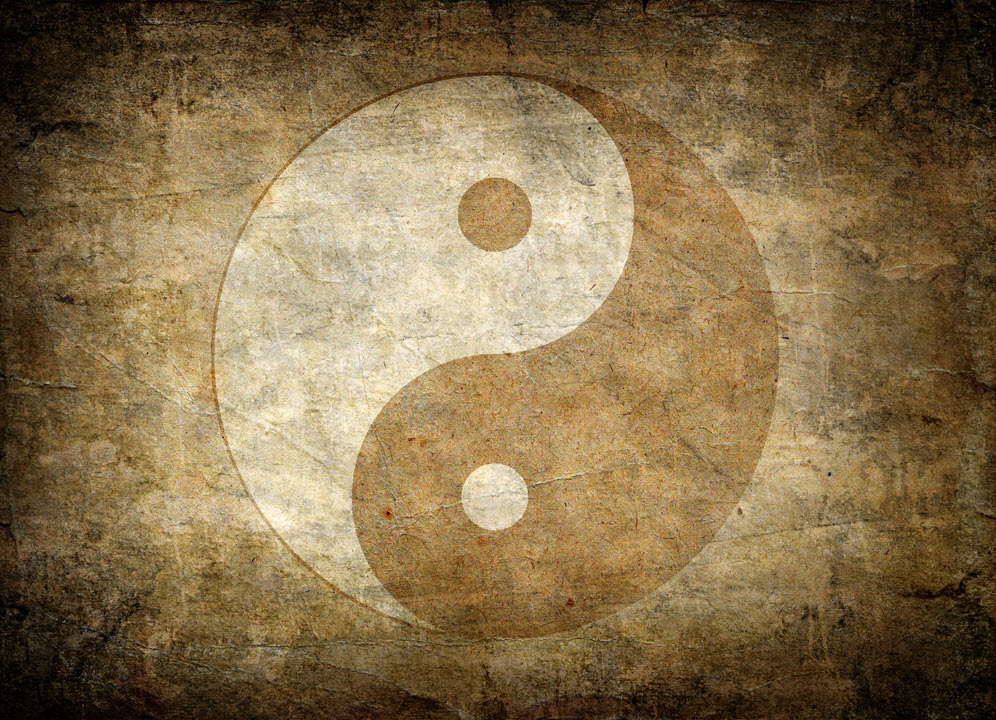
The Taiji symbol (known as the Yin-Yang symbol)

The symbol shown above represents the permanent interaction between Yin and Yang. Like the two faces of a coin, Yin and Yang cannot be separated. The symbol also shows that nothing is entirely Yin or Yang: within each thing there is also its opposite, which at first appears only as a point, a potential for action or state, and which grows over time. You will find many representations of the Taiji symbol, but the correct one is the one in the image, with Yang on the left side, reaching its maximum at the top, and Yin on the right side, reaching its maximum at the bottom. This is because maximum Yang is found at the top of the symbol, corresponding to the direction South in Feng Shui diagrams, the Fire phase and the season of summer. The transition from Yang to Yin takes place on the right side of the symbol and corresponds to the direction West, the Metal phase and the season of autumn. Maximum Yin is at the bottom of the symbol and corresponds to the direction North, the Water phase and the season of winter. The transition from Yin to Yang takes place on the left side of the symbol and corresponds to the direction East, the Wood phase and the season of spring. That leaves the Earth phase, for which there are two versions: it can be placed between Fire and Metal on the circle, corresponding to the last part of summer, or it can be shown in the center as the symbol of balance.
Looking for a personalized analysis of your space or destiny?
Contact us for Feng Shui, BaZi or QiMen consulting. We offer clarity, authentic traditional solutions and precisely calculated remedies.
Recommended articles
The Five Elements Theory
Although the term Five Elements is commonly used, the correct term is Five Phases, referring to wood, fire, earth, metal and water. They are called Phases because they involve a continuous transformation and interaction among them.
The Eight Trigrams
It is said that the legendary king and sage Fu Xi, around 4500 BC, divided the forces of nature into two categories: those in strong, aggressive motion (active) and those that do not move, that are quiet and passive (inactive)...
Xuan Kong Feng Shui
Xuan Kong means the Flying Stars School and is the oldest and most authentic school of Feng Shui. It has two components: Xuan Kong Fei Xing (the Flying Stars system) and Xuan Kong Da Gua (the method of the 64 hexagrams)...